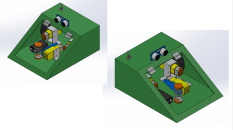
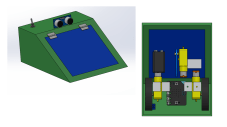
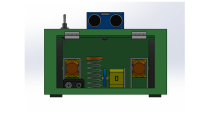
Base is a laser cut piece of acrylic
Laser cutting is a technology that uses a laser to slice materials. While typically used for industrial manufacturing applications, it is also starting to be used by schools, small businesses, and hobbyists. Laser cutting works by directing the output of a high-power laser most commonly through optics. The laser optics and CNC are used to direct the material or the laser beam generated. A commercial laser for cutting materials uses a motion control system to follow a CNC or G-code the same as a 3D printer of the pattern to be cut onto the material. The focused laser beam is directed at the material, which then either melts, burns, vaporizes away, or is blown away by a jet of gas, leaving an edge with a high-quality surface finish.
Advantages of laser cutting over mechanical cutting include easier work holding and reduced contamination of workpiece (since there is no cutting edge which can become contaminated by the material or contaminate the material). Precision may be better, since the laser beam does not wear during the process. There is also a reduced chance of warping the material that is being cut, as laser systems have a small heat-affected zone. Some materials are also very difficult or impossible to cut by more traditional means.
Step 1: Importing a CAD file and setting up parameters for the laser to follow.
Step 2: Open the hood of the laser and position the Perspex sheet in place.
Step 3: Start-up the Laser.
Step 4: Laser begins to engrave Perspex acrylic.
Step 5: Laser proceeds to cut the substrate.
The environmental impact from laser cutting plastics is primarily due to the fumes. The risk is dependent on the type of plastic. The fumes from certain types of plastics can be harmful to health, while others are harmless. Acrylic is by far the most laser cut material, then polyester, polycarbonate, and PVC in smaller quantities. acrylic, which is not harmful to the environment. However, fumes from laser cut acrylic has a distinctive smell that can cause discomfort, polycarbonate contains the substance “Bisphenol A” which is suspected of being an endocrine disruptor (Endocrine disruptors are chemicals that can interfere with endocrine (or hormonal) systems at certain doses. These disruptions can cause cancerous tumours, birth defects, and other developmental disorders. It is tempting to laser cut PVC. The result of laser cut PVC sheets are ok, but PVC releases hydrochloric acid when laser cut. The fumes will etches the machines and is harmful to the operators of the machines. Many coloured foils also contain PVC softeners – a fact that many are not aware of and therefore expose themselves to a small but constant concentration of hydrochloric acid.


Wheels are going to be made out on the lathe
A lathe is a machine tool that rotates a workpiece about an axis of rotation to perform various operations such as cutting, sanding, knurling, drilling, deformation, facing, and turning, with tools that are applied to the workpiece to create an object with symmetry about that axis, Most suitably equipped metalworking lathes can also be used to produce most solids of revolution, plane surfaces and screw threads or helices. The workpiece is usually held in place by either one or two centers, at least one of which can typically be moved horizontally to accommodate varying workpiece lengths. Other work-holding methods include clamping the work about the axis of rotation using a chuck or collet, or to a faceplate, using clamps or dog clutch.
Facing is the process of removing metal from the end of a workpiece to produce a flat surface When a lathe cutting tool removes metal it applies considerable tangential (i.e. lateral or sideways) force to the workpiece it should be flat, and perpendicular to the lathe axis. Facing is used to cut work to the desired length and to produce a surface from which accurate measurements may be taken.
Parallel Turning
This operation is adopted in order to cut the metal parallel to the axis. Parallel turning is done to decrease the diameter of the metal
The tailstock of a lathe can be used for drilling, with the aid of a drill chuck attachment
The usual starting point for drilling with a centre lathe is to use a countersink bit. This is used to drill slightly into the material and creates a starting point for other drills that are going to be used. Once a hole has been produced by a centre drill, machine twist drills can be used to enlarge the hole and if necessary, to drill all the way through. If a large diameter hole is needed, then a small hole is drilled first (e.g. 4mm dia). Then the hole is enlarged approximately 2mm at a time. Trying to drill a large diameter hole in one go will inevitably lead to the drill bit over heating and then jamming in the material. This is potentially dangerous.
Knurling is a process of impressing a diamond shaped or straight line pattern into the surface of a workpiece by using specially shaped hardened metal wheels to improve its appearance and to provide a better gripping surface.


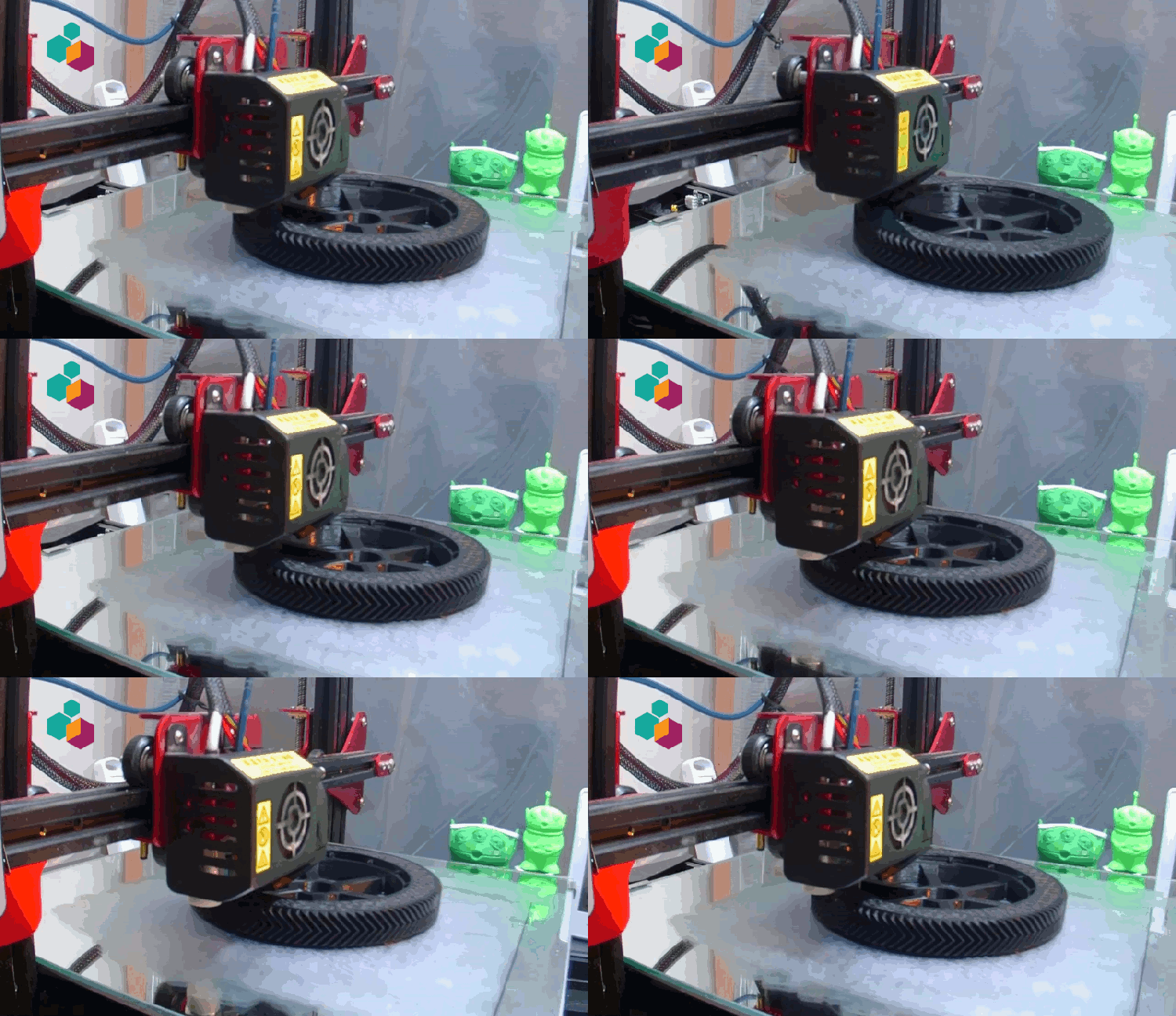
Motor mounting bracket 3D printed
The 3D printing process builds a three-dimensional object from a computer-aided design (CAD) model, usually by successively adding material layer by layer, which is why it is also called additive manufacturing.[1] The term “3D printing” covers a variety of processes in which material is joined or solidified under computer control to create a three-dimensional object,[2] with material being added together (such as liquid molecules or powder grains being fused together), typically layer by layer. s of 2019, the precision, repeatability, and material range have increased to the point that some 3D-printing processes are considered viable as an industrial-production technology, whereby the term additive manufacturing can be used synonymously with “3D printing”. One of the key advantages of 3D printing is the ability to produce very complex shapes or geometries, and a prerequisite for producing any 3D printed part is a digital 3D model or a CAD file.
The most-commonly used 3D-printing process (46% as of 2018) is a material extrusion technique called fused deposition modeling (FDM).[4] While FDM technology was invented after the other two most popular technologies, stereolithography (SLA) and selective laser sintering (SLS), FDM is typically the most inexpensive of the three by a large margin, which lends to the popularity of the process.
Slicing is dividing a 3D model into hundreds or thousands of horizontal layers and is done with software. Some 3D printers have a built-in slicer and let you feed the raw .stl, .obj or even CAD file. When your file is sliced, it’s ready to be fed to your 3D printer. This can be done via USB, SD or internet. Your sliced 3D model is now ready to be 3D printed layer by layer.
G-code is a language that humans use to tell a machine how to do something. With 3D printing, g-code contains commands to move parts within the printer. G-code consists of G- and M-commands that have an assigned movement or action.
Example code:

11 → Indicates the line of code and is used for reference
G/M → Blue Text is a G- or M-command
Red Text defines certain parameters
F → Speed
X/Y/Z → Coordinates
E → Feeder movement
 PN4056